

Microelectronics Facility Design: Precision, Performance, and Purpose-Built Flexibility
Microelectronics technology touches nearly every aspect of modern life – from smartphones and satellites to medical imaging machines and wine coolers. Inside many day-to-day items we maytake for granted is a computer chip, and behind each chip is a purpose-built space, a fab, where precision and control drive performance.
A typical fab has HEPA-filtered air, stringent air change requirements, temperature and humidity controls, scores of hazardous gases and liquid chemicalsthe worst of which are toxic and explode upon contact with air. Planning these facilities requires a level of specialization, foresight, and adaptability well beyond what’s needed for a standard lab or other controlled environment project.
A Different Kind of Design Challenge
What sets microelectronics facilities apart? Complexity.
These are among the most demanding environments you can build. Whether for R&D, academia, or full-scale production, every design decision should be informed by the mission and operational priorities of the users. These often include cleanliness, resiliency, cost efficiency, accessibility, environmental protection, flexibility, and security. Safety is non-negotiable.
These priorities can often appear to conflict with one another. Our job is to understand the users’ core drivers and come up with design solutions that maximize outcomes without compromising values.
The best-planned of these facilities are designed from the inside out. We begin with the tools, the processes, and the users. That foundation defines the program requirements, and the building and systems follow. A successful facility doesn’t just contain a program, it enables it.
Cleanrooms: Designed to Fit the Mission
Cleanrooms and their toolsets are the functional core of any microelectronics facility. Design that accurately captures toolset requirements, configurations, and process flows embeds long-term operational considerations and adaptability from day one. Overdesign and you’re wasting capital; under-design and you’re boxed in.
A common misconception is that every cleanroom needs to resemble a mega-fab. In reality, many successful first-build facilities are 10,000 square feet or less. The right
solution is rarely off the shelf. Cleanrooms need to be scaled to today’s goals and prepared for tomorrow’s shifts in programs, processes, and production targets.
From airflow strategy to vibration control to material movement, every design decision must reinforce core performance needs. That starts with early, focused collaboration to understand the full technical and operational landscape – tools, utilities, personnel, and workflows.
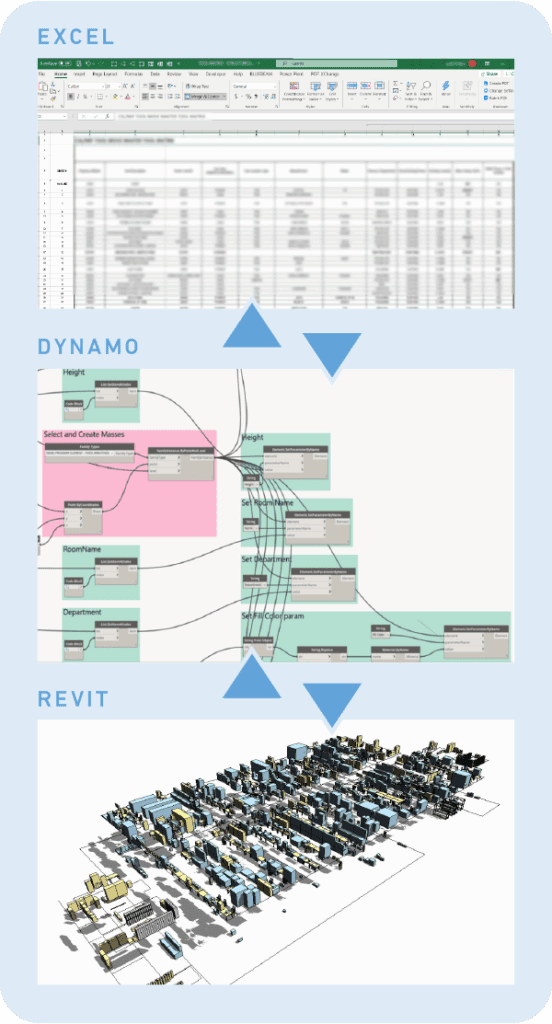
Integrated process equipment (tool) data management matrix
Smart Data Management Fuels Better Design
On one current federally funded R&D project, we’re consolidating dozens of aging labs into a single high-performance facility. Beyond the consolidation of space, we’re collaborating with a multitude of user groups and consolidating systems, data, and operations.
Every microelectronics project should begin with a comprehensive tool matrix, whichcaptures the facility’s equipment and maps it to key requirements: physical characteristics, utility demand, vibration sensitivity, hazardous material interfaces, and more. In this case, we’re managing data on over 1,000 tools and hundreds of thousands of associated data points.
At that scale, manual data management is inefficient and risky. That’s why we’ve built a “smart” matrix linked directly to our 3D model. Inputs can be updated in real time across disciplines, eliminating double entry, catching errors early, and freeing up our best minds to focus on strategic challenges.
The payoff is substantial: better decisions, fewer mistakes, and a facility built on better data.
Creative Solutions for Complex Needs
No two microelectronics projects are the same. That’s why early-stage programming matters so much. When users, engineers, and subject matter experts come to the table together, hidden constraints and surprising opportunities emerge.
Take a defense and aerospace client tasked with renovating an existing shell to house an advanced, utility-dense program. Safety, security, resiliency, and budget were key drivers. Ultimately, the building’s constraints shaped much of the path forward. Through intensive collaboration, we reconfigured the space into a secure, clean, high-performance cleanroom that enables some of the most advanced deep space technology in the world.
At GE Healthcare, we worked with the client and builder to deliver a cleanroom leveraging real-time particle monitoring to dynamically control air recirculation. Backed by the team’s collective experience and leveraging performance-based design, we reduced both the size
and energy consumption of their cleanroom air handlers – achieving a 75% reduction in recirculation rates compared to outdated prescriptive guidance. The facility became the first ISO-classified cleanroom of its kind to achieve LEED Gold certification. Uncompromising cleanliness and sustainability don’t need to be at odds – they can be mutually reinforcing when approached strategically.
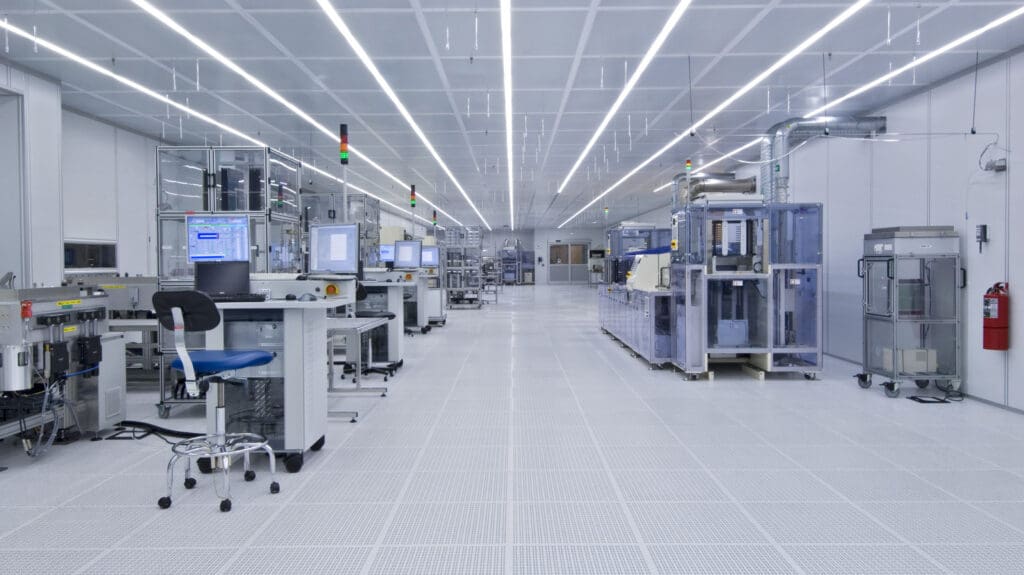
GE Healthcare Digital X-Ray Detector Manufacturing Facility
What Clients Want Now
Today’s clients operate in high-stakes, high-speed environments. Whether it’s to bring a prototype to market, proof of concept, or to meet aggressive production goals, the pressure to move fast is real. That’s why speed to value has become a central theme in design conversations.
Clients increasingly favor phased construction strategies that allow critical operations to begin early, even as other parts of the facility are still coming online. It’s about sequencing smartly to accelerate impact.
Sustainability has moved from aspirational to expected. Microelectronics will always demand serious resources, but today’s clients are proactively seeking ways to cut water and energy use, reduce embodied carbon, and plan for regulatory certainty. We’re helping them implement:
- Zero-wastewater and water-recycling systems
- Adaptive HVAC and cleanroom airflow strategies
- High-performance envelopes
- All-electric and renewables-ready infrastructure
More and more, facility managers and global engineers are driving sustainability with urgency and technical fluency. They want buildings that perform and endure, with fewer tradeoffs.
Collaboration Drives Results
Complex facilities demand integrated teams. Every decision—from tool layout to air change rates to equipment access—has ripple effects. Silos create friction. Coordination builds momentum.
That’s why we embrace collaborative delivery models that allow for early problem-solving, shared accountability, and aligned incentives. With the right team structure, we can:
- Reconcile requirements with constructability
- Anticipate roadblocks and solve them early
- Reduce redesign, rework, and change orders
- Build trust and deliver lasting results
More than just buildings, these facilities are catalysts for innovation. With precision, flexibility, and collaboration, we help clients position themselves for speed, resilience, and long-term success.