
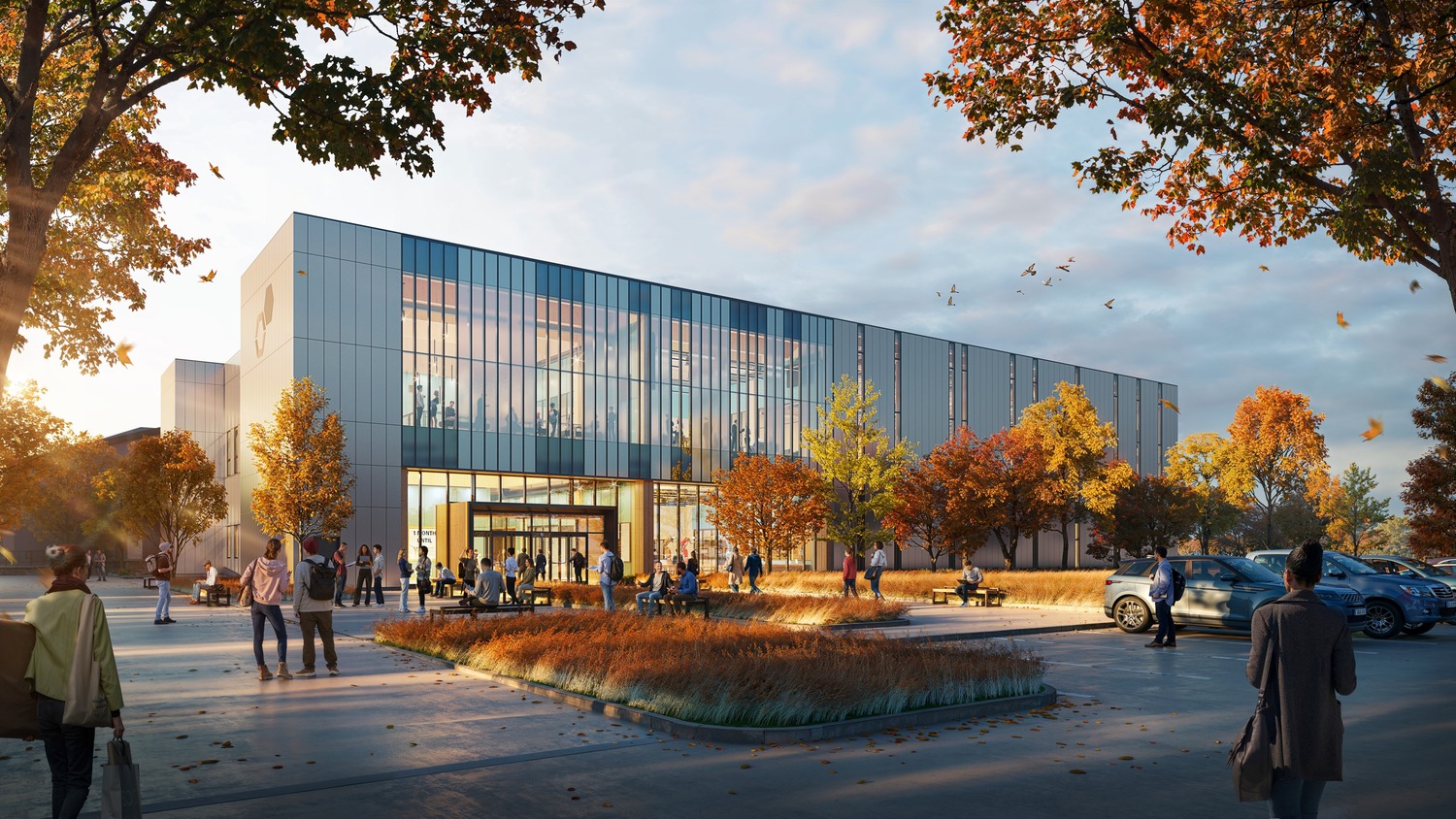
The Factory of the Future Needs a Building to Match
In 2022, the University of Maine (UMaine) printed a house. A 600-square-foot home, built from wood fiber and bio-resin, printed in two days and assembled on-site in half a day. The floors, walls, and roof are all fully recyclable and were produced by the world’s largest 3D polymer printer at the UMaine campus in Orono.
That project, BioHome3D, was one milestone in the long track record of UMaine’s Advanced Structures and Composites Center (ASCC). Under the leadership of Dr. Habib Dagher, the ASCC has spent decades advancing what large-format additive manufacturing can do: printing the world’s largest 3D-printed boat, developing a deployable composite bridge compact enough to carry into the field and assemble across a river, and now, a house. Each project has pushed the envelope of what was considered possible, and inherently and purposefully posed the question: Can it scale?
The GEM Factory of the Future is where that question gets answered.
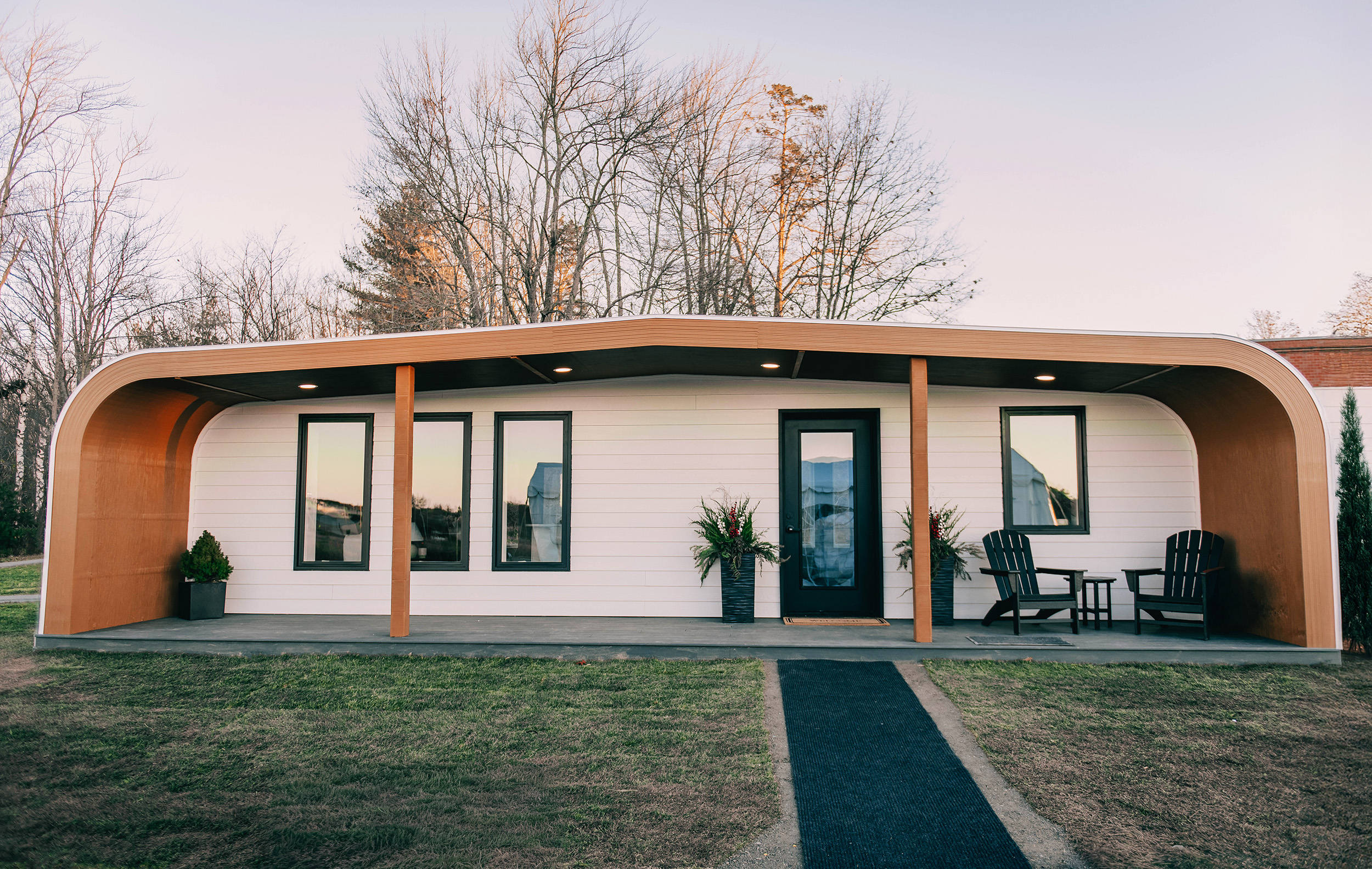
Photo Courtesy of The University of Maine
A Test Bed, Not a Showcase
GEM is a 46,000-square-foot addition to the ASCC, currently under construction and scheduled for completion in late 2026. The facility combines large-scale additive manufacturing bays, CNC and other subtractive manufacturing areas, classrooms, and collaboration spaces designed to bring faculty, students, industry partners, and government agencies together under one roof.
The mission of GEM is to prove out novel, large-format 3D-printed products that can be produced at the speed and volume that industry requires, using common, commercial-off-the-shelf equipment that industry is already familiar with and for which there is a robust supply chain. The goal is replicability: an aerospace manufacturer currently printing airplane parts should be able to pivot to printing boats, or housing modules, without acquiring an entirely new capital base. GEM is built to demonstrate that potential and feasibility.
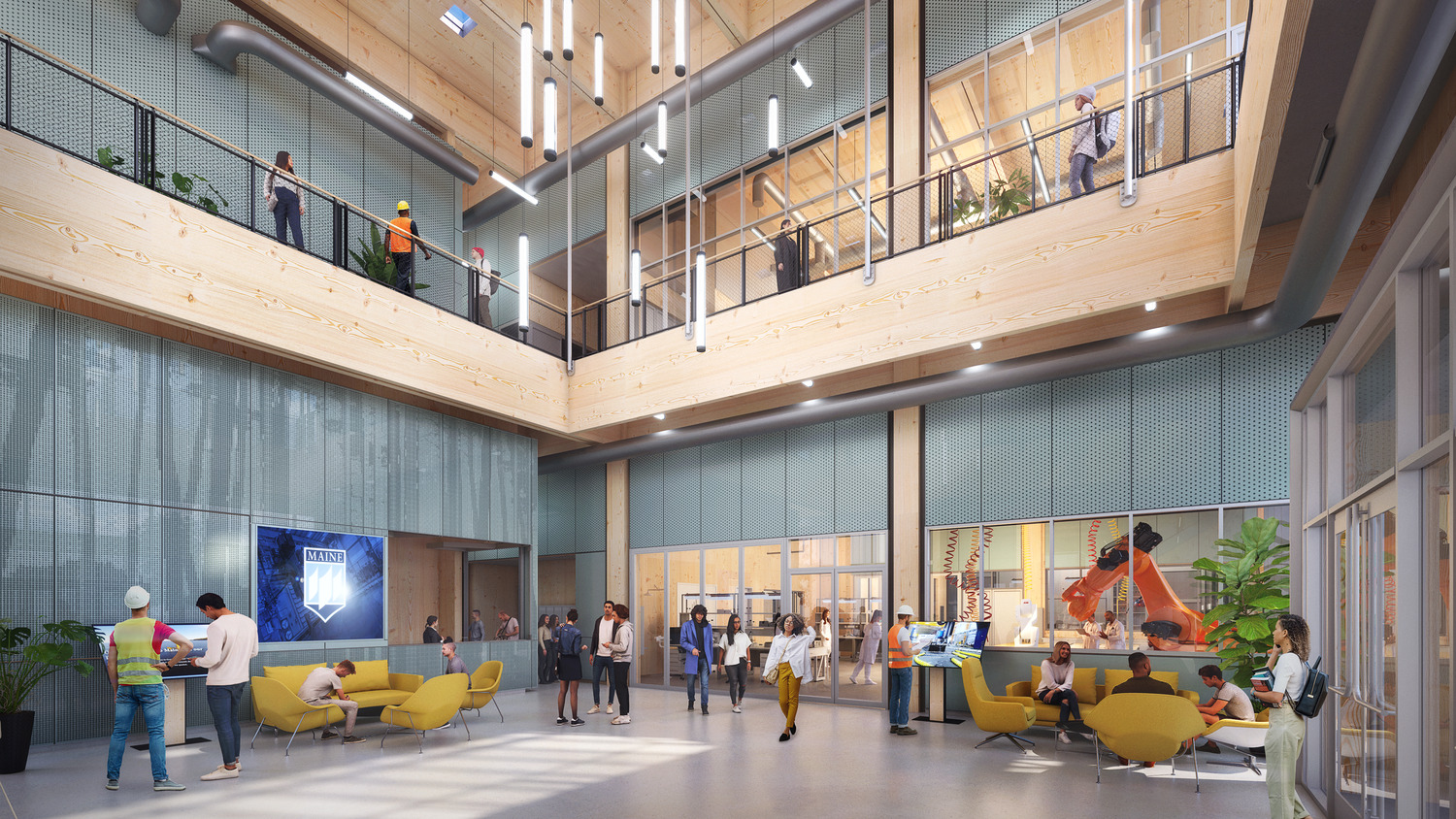
What Makes GEM Different
Many conversations about additive manufacturing start with aerospace, where the processes and applications are already established, and the requirements well- understood.
Marine applications are emerging: the UMaine printer’s 40-foot boat, originally developed in response to a Marine Corps need for high-speed watercraft that could withstand intense vibration without the structural fatigue and transmission through the hull seen with aluminum, demonstrated both capability and market interest.
BioHome3D was significant beyond its construction methods. The feedstock, wood-based polymers derived from locally-sourced Maine wood residuals, points toward a supply chain that is renewable, bio-based, recyclable, and has direct connections to a regional forestry industry that would greatly benefit from new technology that drives demand for their products.
Between marine applications, housing, and other potential markets for large-scale additive manufacturing, each application carries its own requirements. GEM is designed to address these in parallel, and to develop the workforce that will carry them forward.
Designing for a Process That’s Ever Evolving
GEM, at a glance, is a straightforward facility. The real engineering challenge was something harder to resolve on paper: planning around the future of a technology with no established precedent today, at this scale. There are no comparable facilities to benchmark. The ASCC team is defining what large-format additive manufacturing at an industrial scale looks like every day, which means the engineering design process had to embrace the idea that even what is possible with today’s technology is a moving target.
The design team drew on SMRT’s experience with private-sector advanced manufacturing facilities. The framework was familiar: define day one requirements, then plan deliberately for what comes next, building infrastructure to support future operations and/or including provisions to support new technology while deferring the capital investment. Both require working with users to build consensus around success factors, pain points, and assumptions, so the resultant facility enables a future vision that isn’t yet fully defined. From our Advanced Manufacturing experience, we’re comfortable with ambiguity around program requirements while also appreciating those critical aspects of design that can make or break, enable or preclude a high performance building.
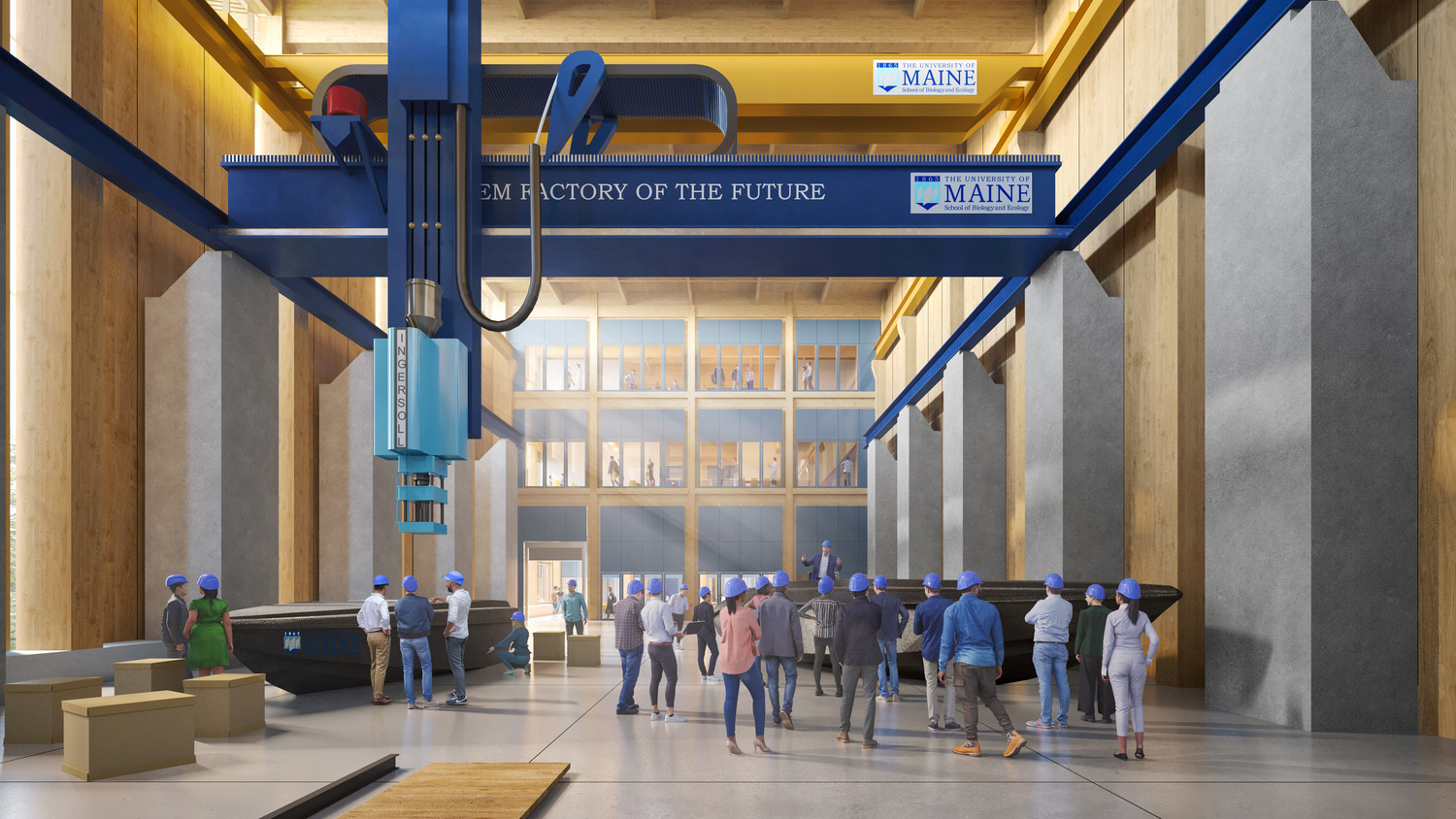
At GEM, the technology evolves faster and less predictably than in something like a microelectronics or pharmaceutical facility. Practical constraints still had to be considered: how does a 40-foot printed object leave the building? How does it get onto a highway or a rail line? How big could a large print five, ten, twenty years down the road be? Consequential considerations like these have to be embedded into aspects of the building, like the structure and circulation planning, before ground is broken.
SMRT worked with ASCC operators and visionaries, equipment vendors, and robotics manufacturing system integrators throughout design to ensure that building systems were selected and configured to support production systems whose definition was being ever-refined. There were also regulatory constraints: GEM is subject to Build America, Buy America Act (BABA) requirements, meaning domestically produced construction materials had to be specified, sourced, and thoroughly documented throughout, and the team had to essentially embed compliance into design decisions from day one.
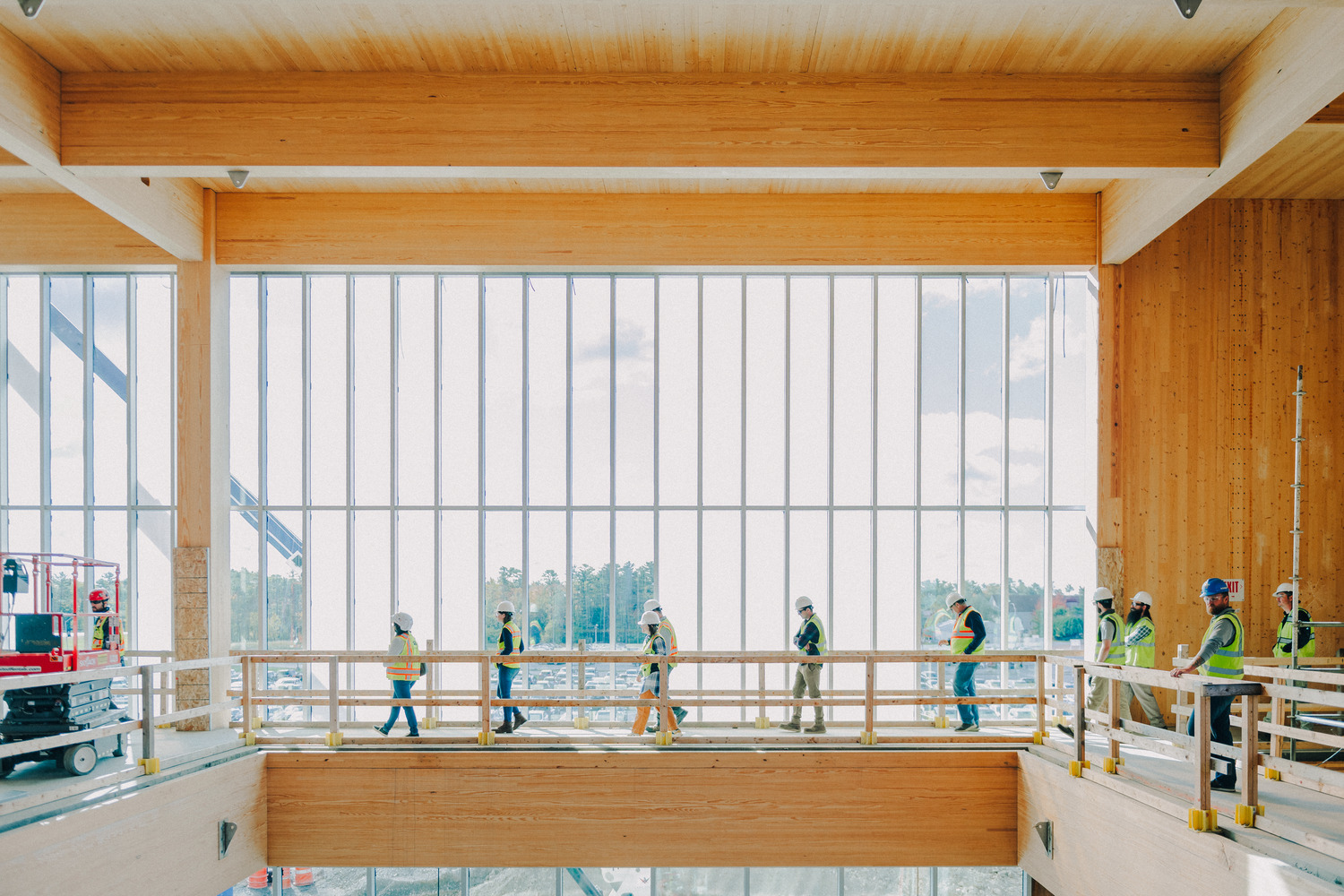
Photo Courtesy of The University of Maine
Sustainability as Design Imperative
GEM is fossil-fuel-free at the primary energy level, built with a hybrid mass-timber structure, low-carbon concrete, and optimized for daylighting and outside air circulation. Whole Life Carbon modeling was conducted at each major design milestone, tracking both operational and embodied carbon, and providing the University with data to inform carbon budget decisions. The result is a projected 20% reduction in greenhouse gas emissions, embodied and operational, over a 60-year period.
GEM’s sustainability story is particularly resonant due to the confluence of what’s happening inside and outside its walls. The building’s structure is mass timber. The research happening within it is advancing wood-based polymer additive manufacturing at the largest scale in the world. And for Maine, the technology being developed at GEM doesn’t offer the promise of a full revival of the wood products industry that was once a cornerstone to the state’s employment and economic output, but it offers hope for potential new markets for forest-derived materials that could give Maine’s timber economy a direction it currently lacks.
What GEM Points Toward
When GEM opens in late 2026, it will be one of the most sophisticated additive manufacturing research facilities in the world, and a working demonstration that the infrastructure for large-format additive manufacturing across aerospace, marine, housing, and applications not yet fully defined can be designed, built, and operated at industrial scale and speed. Moreover, the use of wood-based and recyclable polymers for large-scale 3D printing means that sustainability is ingrained as a cornerstone of this developing technology, and it offers a glimpse of an optimistic future for Maine’s forest products industries.
Additive manufacturing has, for years, pushed the boundaries of what’s possible. Facilities like GEM aim to establish something more durable: the ability to realize those possibilities consistently, at scale, leveraging established industrial infrastructure and supply chains.
GEM is more than a research facility: it’s a bridge between innovation and industry, with the potential to turn Maine’s legacy materials into the foundation of what comes next.
The GEM Factory of the Future was designed by SMRT Architects & Engineers in collaboration with Grimshaw Architects and structural engineer Thornton Tomasetti.
Ben Halleck, PE, is Director of Advanced Manufacturing at SMRT Architects & Engineers. Ben helps clients solve problems across a diverse market spectrum, including microelectronics, automotive, and aerospace. He previously served a decade in the U.S. Navy’s nuclear submarine community.