

The D3 Roster Dilemma and How Facilities Are Adapting
In the world of collegiate athletics, NCAA Division III (D3) schools often stand out for their commitment to balancing the academic and athletic needs of their student-athletes. But there’s another unique and often overlooked challenge these institutions face: roster size. With no cap on team sizes, D3 rosters often swell far beyond their Division I (D1) counterparts. While this inclusivity benefits students, providing opportunities for leadership, teamwork, and life skill development, it can strain athletic facilities that weren’t designed to handle such volume.
As architects and planners, it’s our job to find creative, functional, and forward-thinking solutions to these space challenges. At SMRT, we’ve worked with many private and higher education institutions, but D3 colleges present some of the most dynamic and community-oriented challenges in the collegiate sports landscape.
The Roster Reality
Unlike D1 schools, where scholarships, media exposure, and athletic revenue play central roles, D3 schools are driven by enrollment, academics, and student experience. Without athletic scholarships, students pay to play, and the quality of their athletic experience, including the spaces they train, compete, and recover in, can be a deciding factor in choosing a school.
The numbers are striking: football teams with over 100 athletes; 44 soccer players on one D3 roster, but only 11 on the field at a time. Unlike D1 programs with fixed rosters and defined resources, D3 institutions often have the flexibility to include more student-athletes, boosting tuition revenue and providing entertainment and campus engagement in return. But that comes at a cost: facilities wear and tear, and capacity issues, often operating under tighter budgets and shared-use conditions.
Moreover, these spaces play a crucial role in building school pride and community. Increasingly, athletic departments and recreation directors are advocating for spaces that reflect the personalities of their student-athletes, serve multifunctional needs, and enhance wellness and a sense of belonging.
Designing for Volume and Versatility at Plymouth State
When Plymouth State University (PSU) set out to reimagine their athletic training and strength spaces, they turned to SMRT with a clear challenge: design a facility that could handle oversized rosters and fluctuating demand, without sacrificing performance or flexibility.
The result was the Morgridge Strength and Performance Lab, now the largest D3 strength and conditioning (S&C) facility in the state.
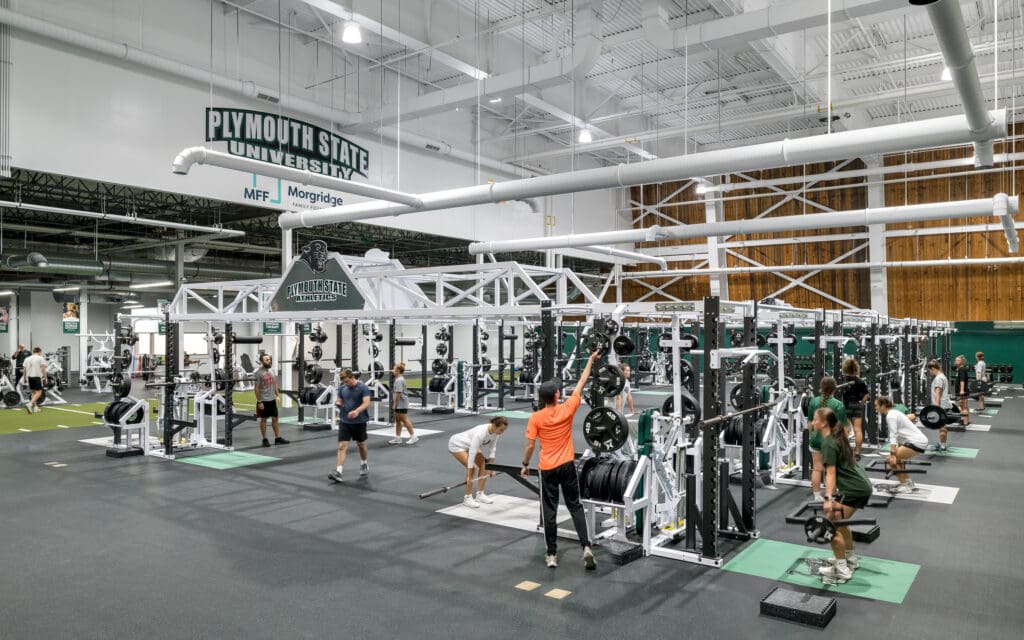
“Our old space could only accommodate a third of our teams at a time. Students had to come in waves, which just didn’t work with their academic schedules,” said the Strength and Conditioning Coach at PSU. With a background at Penn State Football, he brought a high-performance mindset to a D3 context.
The new facility features a turf area that separates team-based heavy lifting from more casual workouts, allowing for general student use and promoting inclusivity. This zoned approach supports both varsity athletics and the broader campus community, allowing for multiple simultaneous activities, an absolute necessity when D3 roster sizes can outpace D1 due to the lack of capacity.
The modular design equipment, ample storage, and open-plan flexibility allow PSU to meet the needs of teams that vary widely in size and scheduling.
Smart Spaces, Stronger Teams at Thomas College
At Thomas College in Waterville, Maine, SMRT designed the Sukeforth Family Sports Center to address another D3 hallmark: multi-use facilities shared by athletics and recreation departments, a setup rarely seen in D1 schools. Here, the Recreation Director and Athletic Director were historically competing for space, scheduling, and funding. Our design helped reconcile that.
The two-story facility features artificial turf slopes outside and carefully organized programmatic zones inside. The lower level is dedicated to athletes: expansive locker rooms with radiant heat flooring, a large athletic training space designed for growth, and a tunnel that symbolically widens as you approach game day, mirroring the student-athlete journey.
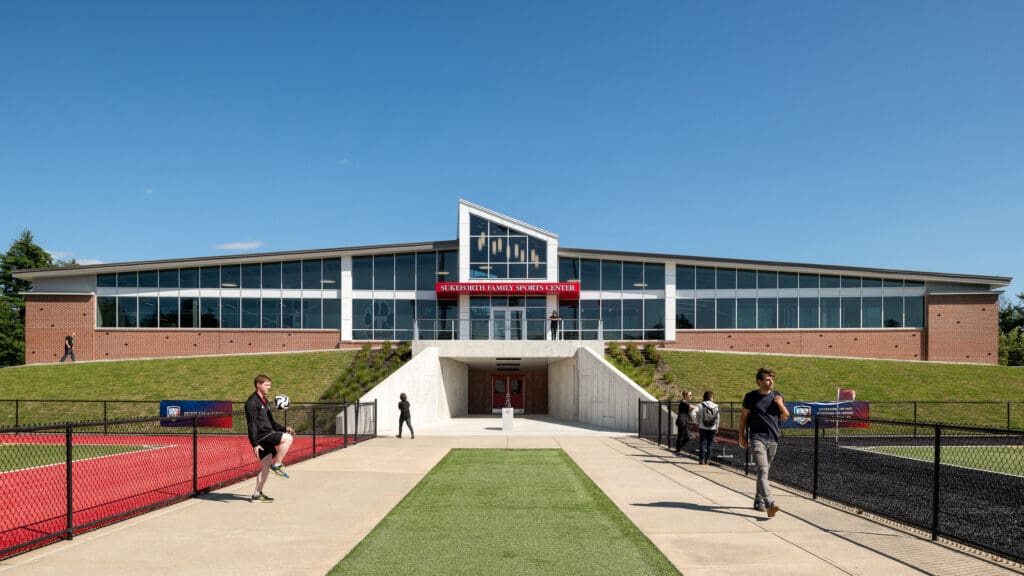
Team rooms are now more than just lockers; they serve as “living rooms for the team family,” complete with LED lighting, TVs, and hangout spaces, all designed to reflect the character of the athletes who use them.
Training rooms also now include private consultation spaces, recognizing the growing need for student-athletes to feel comfortable discussing injuries or wellness in a confidential setting. These changes address not only functional concerns but also broader cultural shifts in athletics: athlete mental health, privacy, and community matter more than ever.
The center’s second level features a deck above the athlete’s tunnel, deliberately placed to give students and parents a glimpse into the athlete experience, helping strengthen campus culture and recruitment narratives.
Strategies That Work
From our work at Plymouth State University, Thomas College, and other D3 institutions, several key design principles consistently emerge:
- Modular Design: Movable equipment and modular storage create flexible, multi-use spaces that can adapt to changing needs.
- Shared Resources: Implementing gender-neutral bathrooms and combining training rooms, locker pods, bathrooms, and meeting spaces reduces redundancy.
- Roster-Informed Planning: With no caps in D3, storage, traffic flow, and locker capacity must account for very large teams.
- Durability Meets Personality: High-traffic areas require durable materials, but they should also reflect the culture and identity of their teams.
- Transparency & Wellness: Natural light, acoustic comfort, and visible connectivity between spaces enhance wellness and reduce friction.
- High-Quality Athletic Experience: Both in practice and on game day, serves as a powerful differentiator for D3 student-athletes when selecting a school.
Looking Ahead
D3 schools are in the midst of an athletics arms race, but one fueled not by media rights or merchandise sales; instead, it’s about enrollment, student life, and a sense of belonging. With zero D3 schools turning a profit in 2021 (compared to just 9 in D1), every design decision must be strategic, impactful, and scalable [NCAA Research, Trends in Division III Athletics Finances, November 2021] [Wide World of College Sports, Hirko, 2022].
At SMRT, we view athletics not just as competition, but also as a recruitment and retention tool, a leadership incubator, a hub of school spirit, and, perhaps most meaningfully, a source of lifelong friendships. We align our work with D3 institutions because we understand their values, which are academic-first and student-centered. We know that smart, tailored design can elevate the student-athlete experience while respecting the budget.
Whether your school is planning a new facility or rethinking an aging fieldhouse, the key is to listen carefully, design intelligently, and build spaces that support both the individual athlete and the entire campus community.