
Designing for a Client Who Held the Line
Sustainable design intentions are easiest to commit to at the start of a project. The harder test comes later, once costs are scrutinized and budgets are finalized, when those early ambitions either hold or get value-engineered into something smaller.
Mölnlycke held the line.
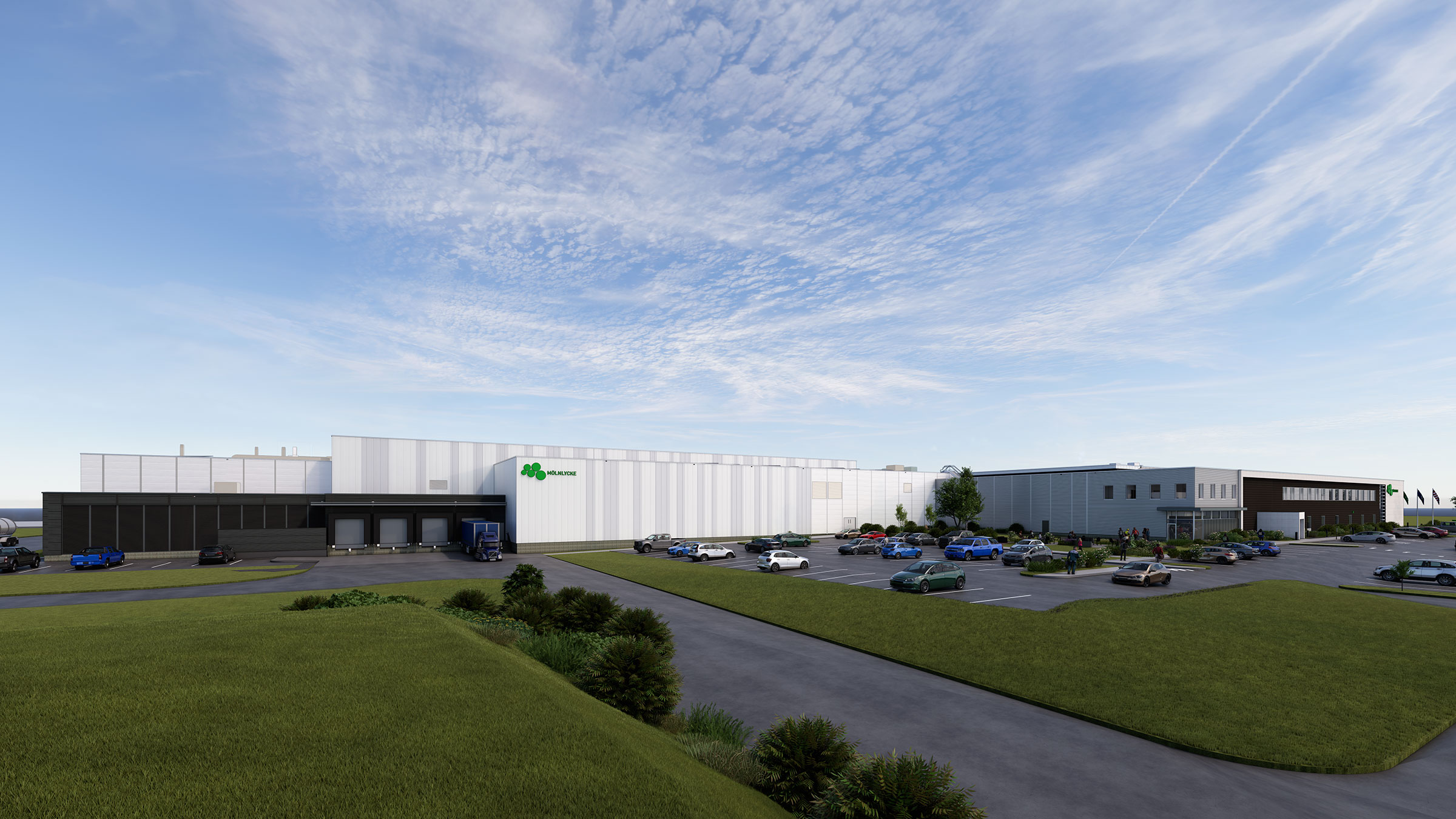
When SMRT began engineering the expansion of Mölnlycke’s manufacturing facility at Brunswick Landing in Brunswick, Maine, the goal was clear: all-electric, decarbonized, with energy recovered at every point the process would allow.
That made our job harder, but it also made it more interesting.
What the Process Demands
Mölnlycke manufactures high-performance wound care dressings. The process is energy-intensive by nature: the product is dried at high temperatures using a 600-kilowatt electric furnace. That furnace introduces significant heat into the building, and the mechanical systems required to manage it are themselves large electrical loads.
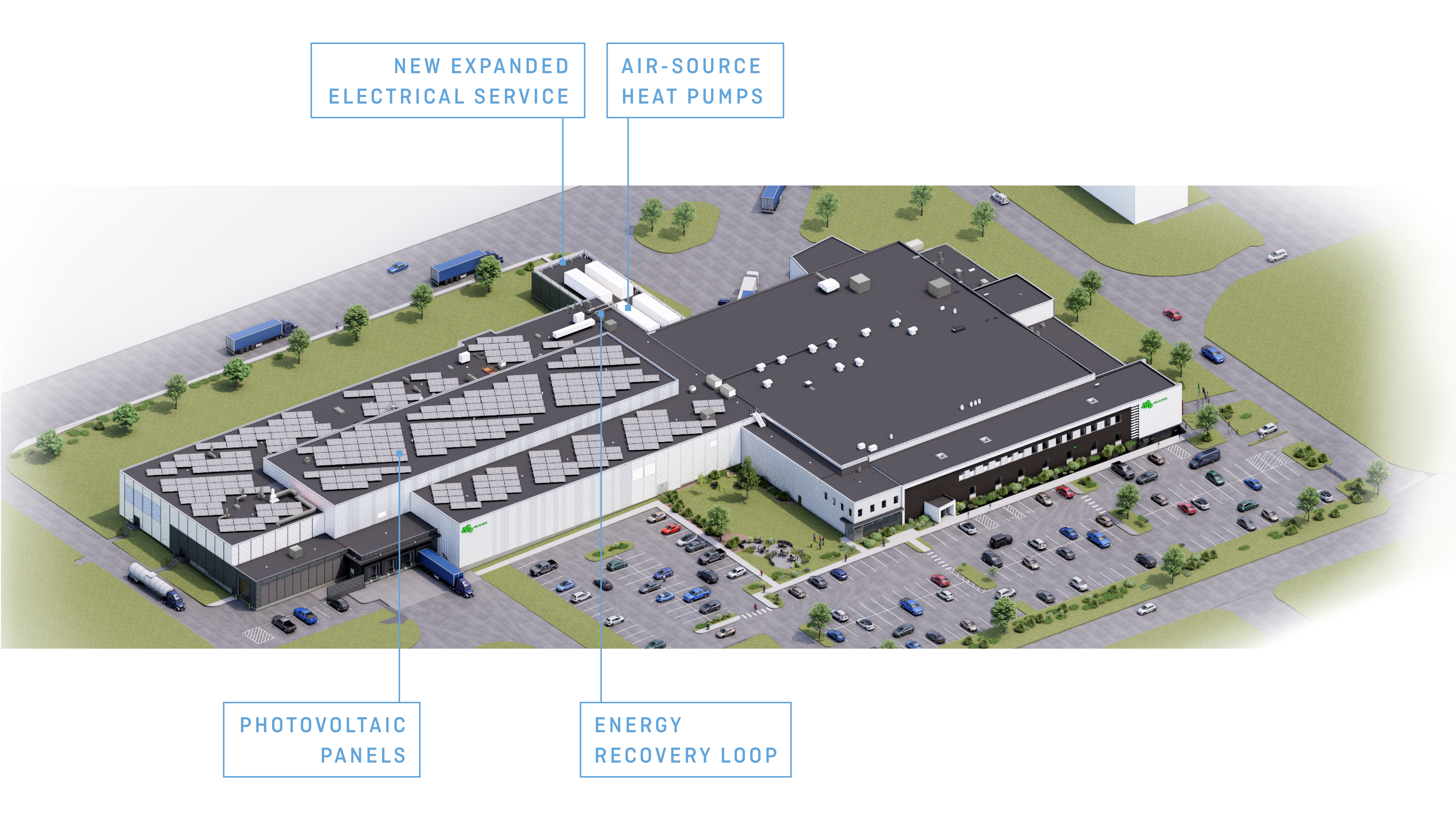
The original facility was built with an electrical infrastructure sized to allow doubling its supply in the future. This expansion required quadrupling it, to which we’re adding a new double-ended 4,000-amp electrical service alongside the existing 2,000-amp service. The electrical load alone reframed every decision downstream.
Replacing the Gas Boiler
In conventional clean room manufacturing, the standard approach is a gas-fired boiler for heat and a chiller for cooling. Given Mölnlycke’s sustainability goals, that wasn’t the path.
The primary system here utilizes 4 pipe inverter scroll air source heat pumps to provide cooling and heating simultaneously. Using this technology in a centralized HVAC system allows for HVAC system flexibility while offering a solution that reduces fossil fuel usage at the building level. Inverter compressors enable efficient load matching, and independent refrigeration circuits minimize defrost impact, enabling the building owner to achieve full electrification without sacrificing temperature control, humidity, or occupant comfort.
A backup boiler remains in place due to Maine’s extreme winters, as they can exceed the heat pump’s operating range, a condition the design plans for rather than works around.
Recovering Heat at Scale
The more technically demanding work was the heat recovery system.
On most projects, waste heat from energy-intensive processes often gets exhausted to the atmosphere. Mölnlycke asked us to recover everything we could.
From the general chemical exhaust systems, a wrap around energy recovery loop was provided between the exhaust and make-up air system, recovering over 1,100,000 BTUs in the peak heating season, and offsetting 98 tons in the peak cooling season.
A single one of their process pieces of equipment exhausts air at temperatures between 225 and 300°F, in volumes ranging from 800 to 4,000 CFM, depending on operating conditions. The design had to perform across that entire range. We developed a multi-stage energy recovery system. The first stage captures an estimated 856,000 BTUs from the high-temperature exhaust. A second stage recovers an additional 234,000 BTUs. That energy is used to pre-treat incoming makeup air and is distributed to the building’s heating system, reducing the peak heating load by approximately 12%.
Getting to the final design took time. Mölnlycke provided a reference system from a similar facility in Sweden, but the systems were different, and the operating conditions didn’t translate directly. We worked through four or five major design iterations, in collaboration with other engineers and vendors, before arriving at a solution we were confident in. We then carried that solution through two or three more rounds of refinement to confirm it would perform across the full range of operating conditions.
Renewable Energy
The roof will be fully covered with photovoltaic panels, installed by a local Maine solar company, supporting the facility’s broader decarbonization goals.
The design team also evaluated wind power as part of the renewable energy strategy. Solar ultimately offered the better fit for this site and this scale, reinforcing the all-electric, fossil-fuel-free approach driving the rest of the project.
Engineering as the Foundation
The decisions documented here, the heat pump system, the multi-stage heat recovery, the electrical infrastructure built to support a process this demanding, are what make Mölnlycke’s sustainability commitment functional rather than aspirational. Every system above it, the architecture, the operations, the building’s case for itself, depends on this groundwork holding up first.
Bill Heil, PE, LC, LEED AP, is a Senior Principal and Lead Electrical Engineer with 34 years of experience designing power, lighting, and life-safety systems for healthcare, industrial, and institutional clients. He is an active member of IEEE and IES, where he has served as president of the Portland chapter.
Kerry Dineen, PE, is an Associate Principal and Mechanical Engineering Discipline Leader at SMRT, where he has led mechanical design across education, healthcare, and advanced manufacturing projects since 2011. He specializes in solving complex mechanical challenges early in the design process, from HVAC to fire protection systems.